 |
 |
 |
 |
 |
 |
 |
 |
 |
 |
 |
 |
 |
 |
 |
 |
In 1872 congress set aside land to create our first national park. The land making up this national park is distributed across three states with 96% in Wyoming, 3% in Montana, and 1% in Idaho. 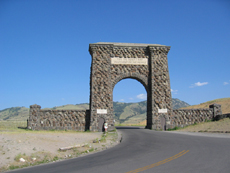 Yellowstone is a Hot Spot, a volcano produced by a plume
of magma that “punches” through
the Earths’ crust. The current Yellowstone Caldera
was created by a massive eruption 640,000 years ago.
Major eruptions occur at 600,000 to 900,000 year intervals.
Yellowstone
National Park is well known for its wildlife and geothermal
features. Today, the forests of Yellowstone help to define
a Subalpine Ecosystem. Lodgepole Pine makes up 80% of
the forested areas.
Engelmann Spruce, Douglas-fir, Subalpine Fir, Whitebark
Pine, and Quaking Aspen are also common. Petrified
wood deposits found in Yellowstone reveal a past environment
and ecosystem very different from the one we enjoy today.
Yellowstone is a Hot Spot, a volcano produced by a plume
of magma that “punches” through
the Earths’ crust. The current Yellowstone Caldera
was created by a massive eruption 640,000 years ago.
Major eruptions occur at 600,000 to 900,000 year intervals.
Yellowstone
National Park is well known for its wildlife and geothermal
features. Today, the forests of Yellowstone help to define
a Subalpine Ecosystem. Lodgepole Pine makes up 80% of
the forested areas.
Engelmann Spruce, Douglas-fir, Subalpine Fir, Whitebark
Pine, and Quaking Aspen are also common. Petrified
wood deposits found in Yellowstone reveal a past environment
and ecosystem very different from the one we enjoy today.
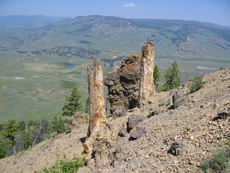
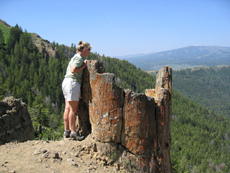
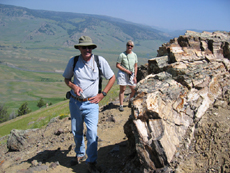
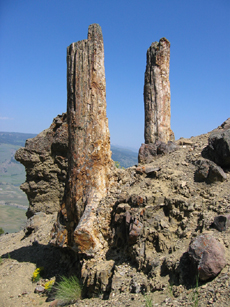
Stumps
at specimen ridge are rooted in fine-grained tuffaceous Trees buried in Quaternary fluvial volcaniclastic sediments and lahars at Mount St. Helens in Washington serve as a modern analogue for the Eocene aged volcanic deposits found in Yellowstone. Karowe and Jefferson (1987) examined trees buried in lahars and fluvial sediments by the 1980 eruption of Mount St. Helens. Trees buried in lahars or mudflows dated at 1885, A.D. 1450-1550 and 36,000 years B.P. were also investigated. Characteristics of trees buried in situ or in place were compared with those buried during transport (allochthonous burial). Trees transported by fluvial volcaniclastic sediments at Mount St. Helens are poorly preserved and damaged by abrasion. Most trees transported by fluvial sediments were in a horizontal or inclined position, with many forming log jams. Although rare, trees transported upright were found to have a height no greater than 2 m with broad root mats measuring 1.5 m wide. These dimensions made them stable for being transported upright. The roots of trees transported upright are encased within mudflow matrix, thus they are not in a layer representing soil (Karowe & Jefferson, 1987, p. 197). Trees buried in mudflows were found to be well preserved. Mudflows encased both transported trees as well as trees buried in place. The 1980 eruption produced mudflows that exposed trees buried by an 1885 lahar. The exhumed trees measured up to 7 m tall and 1 m in diameter. The tops of these trees are near the surface level of the 1885 mudflow, exhibit poor preservation and are covered with root systems from plants that grew after the eruption. Root systems of the upright trees penetrate a finer-grained matrix below the mudflow deposit that is laterally continuous, representing a soil-like layer and indicating in situ burial. Horizontal trees uprooted or snapped off and subsequently transported by the 1980 mudflow were deposited alongside the 1885 upright trees. At another site, root systems embedded in undisturbed layers provided evidence for trees buried in situ during a 1482 eruption. Trees buried in a mudflow dated at 36,000 years B.P. were found to have excellent preservation, showing that wood can be buried in lahar deposits for thousands of years without substantial decay (Karowe & Jefferson, 1987, pp. 192-196). Trees
buried in situ at Mount St. Helens share similar characteristics
with fossil trees exposed at Specimen Ridge.
Upright trees at Specimen Ridge are tall, with their sheared
off tops coinciding with the upper surface of the mudflow
units in which they were encased. The upper portions of
the trees were poorly preserved. The root systems of the
fossil trees penetrate a finer-grained matrix that is laterally
continuous for many meters and positioned below the volcanic
sediments (Karowe & Jefferson, 1987, pp. 201 & 202).
The fine-grained matrix in which the roots are found is
interpreted as a palaeosol. Thus, evidence at Mount St.
Helens and at Specimen Ridge supports an in situ burial
model for the upright trees of Yellowstone. Will trees buried in these lahar deposits eventually become petrified? Karowe & Jefferson (1987) examined the wood found at Mount St. Helens for the initial stages of silicification. Wood buried in the 1980 eruptions showed no significant silica deposition. Wood buried in 1885 and A.D. 1450-1550 exhibited silica deposition on cell walls along with some decomposition. In wood dated at 36,000 years B.P. silica had penetrated cell walls. Break down of cell walls had also occurred. Karowe and Jefferson (1987) concluded that the increase in silica deposition as well as decay associated with trees buried in mudflows at Mount St. Helens supported the currently accepted theory of silicification (p. 203). The apparent increase in silica deposition over time was an exciting find. However, researchers at the University of Bonn were unable to reproduce the results of Karowe and Jefferson even when using specimens prepared from the same trees (Hellawell, Gee, Ballhaus, Clynne, and Sander (2011). Perhaps Karowe and Jefferson were looking at an instrumental artifact. Scientists at the University of Bonn are currently working on a paper that will explore the results of their study in more depth. It
is clear that many petrified wood deposits, such
as those found in Yellowstone, are associated
with ancient volcanic mudflows. George Mustoe from Western
Washington University has examined many Holocene wood
specimens from mudflows and has found no evidence
of silicification
(Mustoe, written personal communication, 2012). Read
our article Petrified
Wood: The Silicification of Wood by Permineralization to
explore possible pathways and the time needed to
form petrified wood. Click
on Specimen
Ridge for a printable version of this
article. |
Bibliography |
Anderson
R. & Anderson, L. (2000). A Ranger's Guide to Yellowstone
Day Hikes [Updated Edition]. Canada: Farcountry Press. Hellawell,
J., Gee, C. T., Ballhaus, C., Clynne, M. A. and Sander,
P. M. (2011). Silicification of wood: identifying ancient
and present-day processes. Abstract for poster presentation,
The Palaeontological Association 55th Annual Meeting, Plymouth
University, UK. Fritz, W.J. (1981). Reply to Comment on “Reinterpretation of the depositional environment of the Yellowstone “fossil forests”: Geology, v. 9, p. 53-54. Fritz, W.J. (1984). Comment and Reply on “Yellowstone fossil forests: New evidence for burial in place”: Geology, v. 12, p. 638-639). Karowe, A.L. & Jefferson, T.H. (1987). Burial of Trees by Eruptions of Mount St. Helens, Washington: Implications for the Interpretation of Fossil Forests. Geological Magazine, vol 124, no. 3, pp. 191-302. Kenrick, P. and
Davis, P. (2004). Fossil Plants. Smithsonian
Books: Washington. Mustoe, G. E., (2012) Written Personal Communication. Retallack, G. (1981). Comment and Reply on “Reinterpretation of the depositional environment of Yellowstone fossil forests”: Geology, v. 9, p. 52-53. Yuretich, R.F. (1984). Yellowstone fossil forests: New evidence for burial in place: Geology, v. 12, p. 159-162. Yuretich, R.F. (1984). Reply to Comment on “Yellowstone fossil forests: New evidence for burial in place”: Geology, v. 12, p. 638-639). |