 |
 |
 |
 |
 |
 |
 |
 |
 |
 |
 |
 |
 |
 |
 |
 |
The word fossil is derived from the Latin fossilis, which means "dug up". Initially, the term fossil applied to any strange or interesting material found within rock whether or not it was of organic origin (Prothero, 2004, p. 5). Most modern definitions include the concept that fossils are evidence of ancient organisms, which have become a part of the Earth’s crust. The word ancient is arbitrary. To some ancient applies only to extinct organisms while to others it implies time limits. Grimaldi and Engel (2005) point out that many would like to restrict the term fossil to species that have become naturally extinct. They argue that having this knowledge is problematic. Grimaldi and Engel suggest the following practical definition, "...a fossil is the remains or workings of any species, living or extinct, that have been naturally preserved for several thousand years or more (p. 62). A more common time limit defines fossils as being prehistoric thus; fossils preserve remains or activities of ancient organisms older than 10,000 years (Garcia & Miller, 1998, p. 14; Schopf, 1975, p. 27).
The majority of fossils are found in sedimentary rocks. Organisms become trapped within sediment layers due to the action of water, wind or gravity. Fossils can sometimes be found in metamorphic rocks formed from fossiliferous sedimentary rocks altered by heat and pressure. Fossils can even be found in igneous rock created from lahars or pyroclastic flows that entomb trees or other organisms.
Two major types of fossils are recognized. Body fossils reveal the structure of an organism, while trace fossils reveal the activities of organisms. There are many reasons to study fossils. The fossil record indicates that different life forms have existed at different times revealing the evolution of life on Earth. Fossils and rock types serve as clues to determining ancient environments. Finally, fossils are the most practical way of telling time in geology (Prothero, 2004, p. vii). How do fossils form and how are they classified into different preservation types?
Taphonomy or
How Fossils Form
A
Fossil represents evidence of past life that is found in
the Earth’s
crust. Taphonomy ("laws of burial") is the term used to
describe the process that results in the formation of a fossil.
Taphonomy
or
the transition
of an organism or part of an organism from the biosphere to the
lithosphere
is accomplished in basically two steps. The process of burial
or entombment is referred to as biostratinomy. After burial or
entombment, diagenesis begins; the conversion of sediments or other
deposits
to rock. Biostratinomic and diagenetic processes destroy most
traces of organisms. The extent of preservation depends upon what
happens
during biostratinomy and diagensis. The biostratinomy
and diagensis associated with a fossil can reveal much
about the
environment
in
which the
organism lived. In other words, how fossils form can often provide
clues to past environments.
Lagerstätten
Fossilization often occurs as a result of rapid burial, usually by water-borne sediment, followed by chemical alteration. Rapid burial and specific chemical environments help to reduce decomposition from bacteria and fungi. Decomposition, erosion, deposition and rock formation are processes that often destroy soft tissue, so it is the hard parts of organisms such as shells, bones and teeth, which are most often preserved. Occasionally conditions exist that allow for preservation of organisms in environments that rarely produce fossils. Exceptional conditions may also help to preserve soft tissue or impression of soft body parts.
Fossil deposits with soft-bodied organisms well preserved or with terrestrial animals, such as dinosaurs in the Morrison formation are termed Lagerstätten. Lagerstätten is a German word used in mining that denotes a particularly rich seam and has been adopted by paleontologist to signify these rare fossil deposits because they give us a window into past environments seldom preserved in the fossil record (Selden & Nudds, 2004, p. 7). Two types of fossil lagerstätten are recognized. Deposits that contain vast numbers of fossils represent Concentration Lagerstätten. The preservation may not be exceptional, but the great numbers can be very informative. Conservation Lagerstätten contain fossils with soft body preservation, impressions of soft tissue or fossils of well-articulated skeletons without soft tissue preservation. Conservation Lagerstätten are particularly important because they provide knowledge of soft-bodied organisms, allowing paleontologists to reconstruct paleoecosystems, and give insights into the morphology and phylogentic relationships of organisms (Nudds & Selden, 2008, pp. 8-9).
Preservation Types
The
science of taphonomy explores the environmental conditions
that promote fossilization. Both body and trace fossils can
form
under a variety of circumstances representing multiple modes of
preservation. Compare several books on fossils off any library
or bookstore shelf and you will soon realize there is no standard
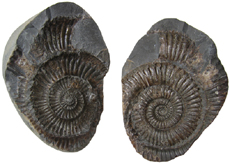
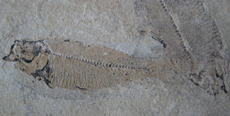
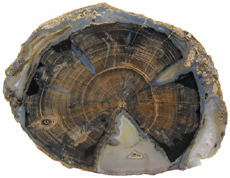
for categorizing types of fossil preservation. Click on the pictures
below to explore modes of preservation
that one is likely to find in both scientific papers and popular
books. A modified, printable version of our articles on fossilization
can be obtained by clicking on Fossils.
 Molds & Casts |
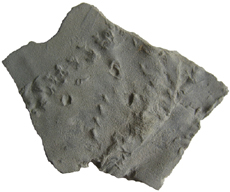
 Imprints & Impressions |
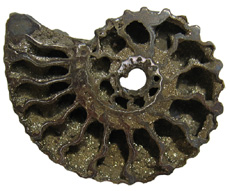
 Permineralization |
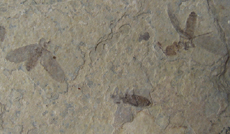 Compressions & Carbonization |
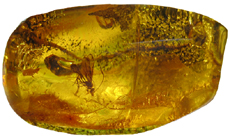 Amber |
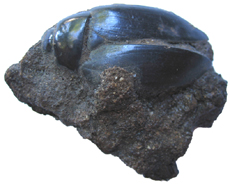 Chemical Preservation |
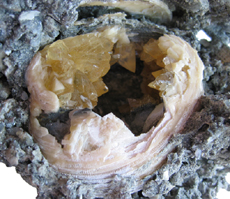 Recrystallization |
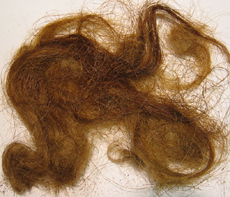 Freezing |
|
|
|
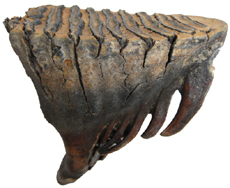
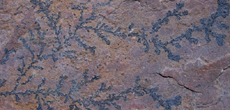 Pseudofossils |
Bibliography |
Garcia, F.A. & Miller, D.S. (1998). Discovering Fossils: How to Find and Identify Remains of the Prehistoric Past. Pennsylvania: Stackpole Books. Grimaldi, D. & Engel, M.S., (2005). Evolution of the Insects. New York: Cambridge University Press. Nudds, J.R. & Selden P.A. (2008). Fossil Ecosystems of North America: A Guide to the Sites and Their Extraordinary Biotas. Chicago: University of Chicago Press. Prothero, D.R. (2004). Bringing Fossils to Life: An Introduction to Paleobiology [2nd edition]. New York: McGraw-Hill. Schopf, J.M. (1975). Modes of Fossil Preservation. Review of Palaeobotany and Palynology, vol 20: pp. 27-53. Selden P. & Nudds, J. (2004). Evolution of Fossil Ecosystems. Chicago: The University of Chicago Press. |